
Your path from first word to fluency.
An adaptive engine – not a syllabus – teaches you a new language directly from one you already speak. No fixed lessons. No rote memorisation.
Mobile apps for iOS and Android – coming soon.
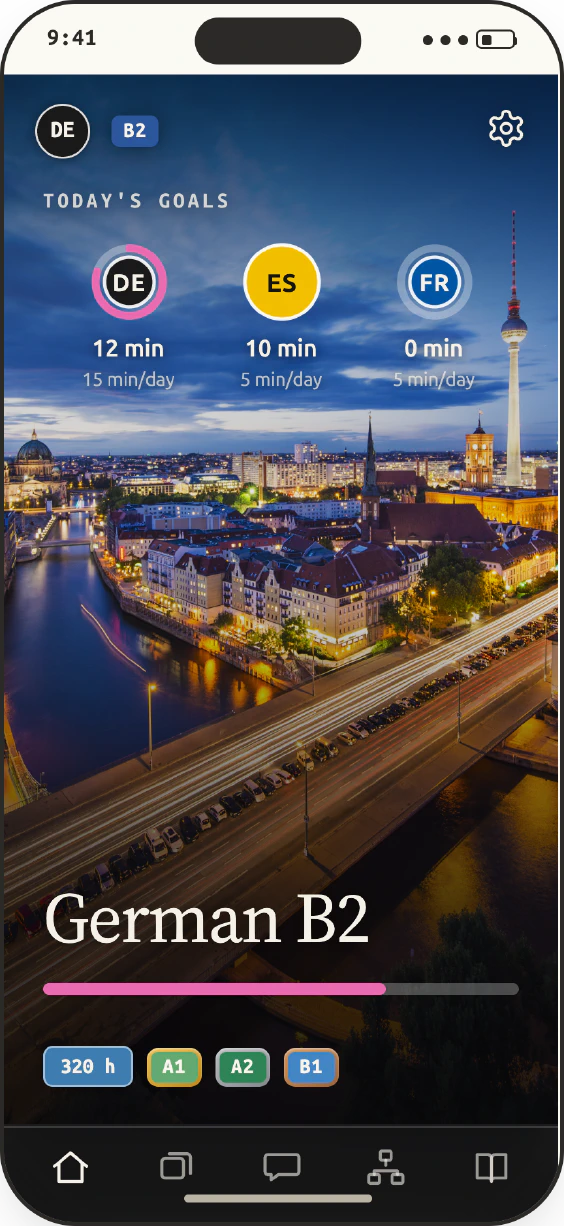 Design preview – work in progress
languages – foreign or native
courses – every language pair, both ways
CEFR levels at launch, C1–C2 coming soon
on-device – every lesson works offline
images that teach words directly
words across six languages
phrases in the phrasebook
native-voice audio clips
Real figures from the engine, across all six languages, as it enters its final quality checks; vocabulary and phrases are still growing.
A precision instrument, not a game.
Built for serious learners. The maths runs quietly underneath; what you meet is calm, considered, and shaped around a language you already speak. No streaks, no points, no mascots – but real awards, earned: CEFR levels, mastery medals, and the hours you put in.
Directly, not through English
Learn Spanish straight from Czech, or German straight from Polish. Every course teaches one language from another – with no English forced in between.
An engine, not a syllabus
There are no lessons. You learn by trying – recalling an answer, then being gently corrected. An adaptive engine builds your own path, one word at a time.
Meaning, made concrete
Where an image can carry a meaning, a real photograph teaches it directly – you grasp mer as the sea itself. Elsewhere, words and phrases translate straight between your two languages.
Learn from your own language.
Almost every language app requires you to speak English. If English isn’t your own language, everything you learn arrives by way of it – and you take the last step of the translation yourself.
Multiglot connects each language directly to every other – so you begin in the language you think in, from your very first word. As far as we know, no other app offers this.
That’s no small undertaking: six languages, each taught from every other, comes to thirty separate courses – and we offer every one.
Czech → German, taught directly – one of thirty such courses.
Three ways in – vocabulary, phrases, grammar.
Start speaking with words and phrases; go as deep into grammar as you wish – all resting on the foundations: the alphabet, numbers, and telling the time. Every word and phrase plays natural audio; speaking practice isn’t part of this version.
Vocabulary
The words themselves, taught through images and natural audio – nouns, verbs, adjectives, and more, levelled A1 to B2.
Phrasebook
Greetings, essentials, and getting by – ready for the moment you need them, and spoken aloud.
Grammar
Learn the forms by doing, not by rules – you combine and practise until the pattern is yours. Not needed to start speaking; there for those who want the depth.
The word, and the world it names.
Words are taught through real photographs and native audio – you meet each one as the thing itself, then in the language you’re learning, not as an English word in disguise.
The same concept, learned directly in any of the languages – and where a word can be shown, a real image does the teaching.






The things people actually say.
Each one comes with clear audio, taught directly between your two languages. It all works offline too, so the flight out is as good a place as any.
The order is the method.
There’s no fixed syllabus. Learning radiates outward from a form you already know – each step a single change away: a number, a demonstrative like this or that, a case. Nearer, commoner forms come first; rarer ones follow.
Real examples, straight from the engine – number, articles, demonstratives, and (in Czech, Polish, and German) case. Each language has its own forms; the engine sets the path.
Base form first
You learn the plain word first, so you can start using the language quickly. Plural, gender, and case come later, through grammar – refining what you can already say, rather than holding you back at the start.
One step at a time
One change at a time means never learning two things at once: the word is already familiar, and only the form is new.
Recognition before production
You meet a form before you’re asked to produce it. Only production – the hardest step – counts towards a CEFR level; recognising it alone never does.
A level is earned in bronze, then deepens to silver, gold and platinum as you go further – more words and phrases, and grammar you can use rather than recognise. It moves only on what you can actually do.
Every session moves you forward.
In about a minute, you make measurable progress – and watch it build towards an estimated CEFR level, on the same scale used across Europe. It is an honest estimate from what you have shown you can do, not a certificate, since some skills like speaking freely live beyond the app.
Accuracy earns quiet medals; real mastery raises the estimate; and your hours add up, whatever you are working on. No streaks to protect, no points to chase – the progress is the learning.
Earned, and yours to keep.
Every mark of progress comes from real learning – and once earned, it’s never lost. No streak freezes, no punishment for going on holiday.
A CEFR level for how far you’ve come, deepening bronze to platinum as you master it. A medal for accuracy. And hours that quietly add up.
How far you’ve come, deepening bronze to platinum.
Awarded for accuracy, section by section.
Your practice, counted a minute at a time.
A minute at a time. Free to learn.
You learn in short, one-minute sessions – five a day on the free tier, drawn from one pool shared across every language you are learning. Everything else is free: each language and pair, all audio, all images, no ads, and it all works offline.
Multiglot Unlimited lifts the daily limit, raises your goal to 15, 30 or 60 minutes, and syncs across your devices. There is no free trial, because the free tier is the demo.
Learn on a plane or abroad – no connection, no roaming, no data needed.
One minute each, from a single pool across all your languages. Unlimited removes the cap.
All six languages, every pair, all audio and images – free, with no ads.
Free and paid earn identically, and progress is never reset – even if you cancel. A Multiglot badge means something.
Six languages, thirty courses.
Learn any of the six from any other – thirty courses in all, each running A1–B2 at launch.
Two choices worth noting: our English is British English – the less common pick – and our Spanish is European Spanish. Levels C1 and C2 follow after launch.
Learning more than one? It’s in the name.
Most learners focus on a single language, and Multiglot is built for that first. Take on several and each can carry its own daily goal, if you set one – switching between them is a single tap. Just exploring? Set no goal at all.
Where we are.
The research
An earlier product, and more than a decade working out how a language is really learned and how to teach it differently.
The web app
Fourteen public releases refined the method with real learners – now retired to make way for the native apps.
The company
Multiglot becomes a company – Multiglot s.r.o., based in Prague.
The engine
All six languages and thirty courses generated, now in final quality checks.
Building the apps
The native iOS and Android apps are in build on the finished language engine.
Launch
Coming to iOS and Android. Join the newsletter to hear the moment they land.
A quiet obsession, long in the making.
Multiglot began as one person’s fascination with how people actually learn a language – and a stubborn conviction that there had to be a better way, if only a course were built differently and the software written more cleverly. The idea goes back to 2011; what exists now is a full language engine that teaches six European languages, each directly from another.
The method, and the engine that powers it, are already built and proven. What’s left is the part you’ll actually hold: the apps.
A computer programmer and DevOps engineer of some fifteen years, working across big-data architecture, distributed systems, and high-availability infrastructure. He has shaped every part of Multiglot – the architecture, the data modelling, and the design of the courses themselves – working alongside professional translators.
Korunní 2569/108, Vinohrady, 101 00 Praha 10, Česká republika
First word, the day the apps land.
A few considered emails as the apps take shape. No noise, no spam.
The newsletter is in English. Unsubscribe any time. We’ll never share your address.